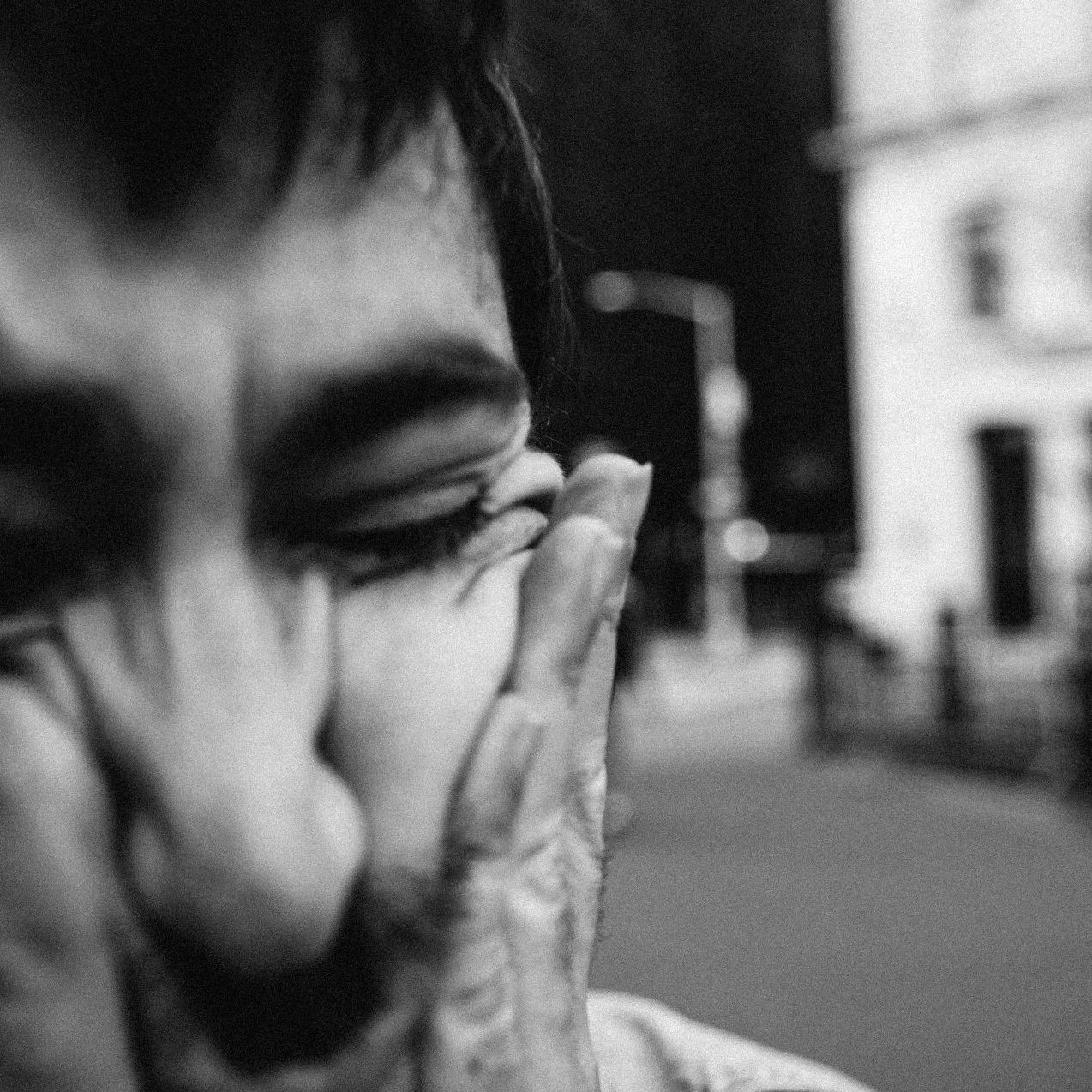
The word ‘here’ applied to my body does not refer to a determinate position in relation to other positions or to external coordinates, but the laying down of the first co-ordinates, the anchoring of the active body in an object, the situation of the body in face of its tasks. Bodily space can be distinguished from external space and envelop its parts instead of spreading them out, because it is the darkness needed in the theatre to show up the performance, the background of somnolence or reserve of vague power against which the gesture and its aim stand out, the zone of not being in front of which precise beings, figures and points can come to light.
(Phenomenology of Perception, The Spatiality of One’s Own Body and Motility, Morris Melreau Ponty)
Before being a collection of organs and parts, the body is a body. It’s the background for action, for interaction, and it certainly comes before reflection— that allows me to distinguish one part from another, which enables me to consider my body as something external to “me.” Thinking of the body as something more than the sum of its parts gains significance against the fragmented perception we’re so used to. We move forward with our thoughts and look back at the body; head, shoulder, back, big part, small part, beautiful part, prominent part, weak, strong… This pixelated view makes us forget the presence of the body of the person in front of us. We are drawn away from what happens right before this dissection; the impression, and perhaps even the beauty of a body, are tied to that overall effect, of the immediate gaze.
The clothes we wear, designed for different body parts, help maintain the awareness of this retrospective division. A shirt for the torso, underwear for the genitals and buttocks, a bra for the breast, pants for the legs, and socks for the feet. The act of dressing in separate pieces of clothing is also reflected in undressing; in revealing body parts one by one, in fetishizing specific parts, in obsessing over one part or another, in seeing a whole body through one element or another. Or to make it precise – we can say, we don’t tend to see a whole body because we focus on one part or another. We can only imagine how we would perceive a body getting dressed and undressed if we all wore a dress (without any underwear)? What if we all wore a kimono and that was it, one piece to see it all.
The physical division of the parts is also found on the naked body, after all, once it’s exposed part by part, the sun tan lines from the swimsuit appear. A tattooed reminder of what was hidden while the rest of the body was exposed. A temporary “coverage tattoo” that makes it harder to return to the perception of the whole body that stands before me, either in the mirror or outside of it.
(And all this doesn’t mean that different parts and the meanings we attribute to them aren’t important. On the contrary, we’re so immersed in these distinctions that most of the significant meanings are rooted in the parts as parts.)
When I say “beauty”, I’m also thinking about art—the kind we look at, the kind we surrender to, the kind that asks something from us and we ask something from it. Ruth Lorand, in her essay “Ethics and Aesthetics – Two Types of Order,” talks about the “sensitivity” of a work of art. She measures the “aesthetics” of a piece, among other things, by how sensitive it is to changes. Simply put, the more a small change affects the entire work, the more sensitive the work is, and consequently, the more “aesthetic” it is. And what does that imply? That the connections between the parts of something are more important than the individual parts themselves. Or at the very least, it’s a perspective (or “Order”) that allows us to examine things differently than just the “sum of their parts”.
Taking this Order into account, I don’t evaluate each shot in a film separately, scoring it, and then summing it up and dividing. I ask—what would happen if this shot were removed? Filmed from a different angle? Would the film change? Would it “work” less? If the answer is yes, even if the shot wasn’t necessarily “beautiful” on its own, it becomes critical to whether the whole work is “beautiful.” Does the work need all its parts? Are its parts sensitively connected to one another? Is it fragile? How much does a slight change throw it off the precise balance in which it’s placed?
(There’s a warning sign here for a show where you would, after watching, come out saying, “Wow, that scene was really beautiful and touching!” What does that say about the rest of the scenes? The more I’m required to address specific details, it suggests the whole is not dealt with in a sensitive manner.)
And what about the body? Instead of trying to forcefully go backward, if we accept that we’re already trapped in this dissecting gaze, we can only hope to move forward from it back to the whole. If we start recognizing the importance of the parts for the whole, in the way they correspond with each other, we might be able to free ourselves from the objectifying gaze on the body and its parts and start seeing it as a subject. If we linger for a moment with a gaze that sees a collection of details and doesn’t seek to zoom in. If we zoom in so much that our eyes close and we lose orientation, the blurring of sense and touch will lead to a bodily experience that doesn’t depend on the part but on the movement. If we look at human beings as art, if we look at ourselves that way

